Semi-Autonomous Twin-Hoist System for Copper-Foil Changeover
Project Overview
Isola’s Chandler facility manufactures copper-fiberglass laminate for printed circuit boards. Its copper-foil roll changeover was a largely manual, two-minute process that could stage only two rolls and created a production bottleneck. Our four-person capstone team designed a semi-autonomous twin-hoist system to move 500–700 lb rolls between a staging pallet and the existing machine chucks.
View repository · Final report · Presentation slides
Requirements and System Design
The industrial partner required a changeover below 40 seconds, capacity for at least four staged rolls, compatibility with the existing 480 V power and 24 V controls, and materials suitable for an ISO Class 6 clean-room environment.
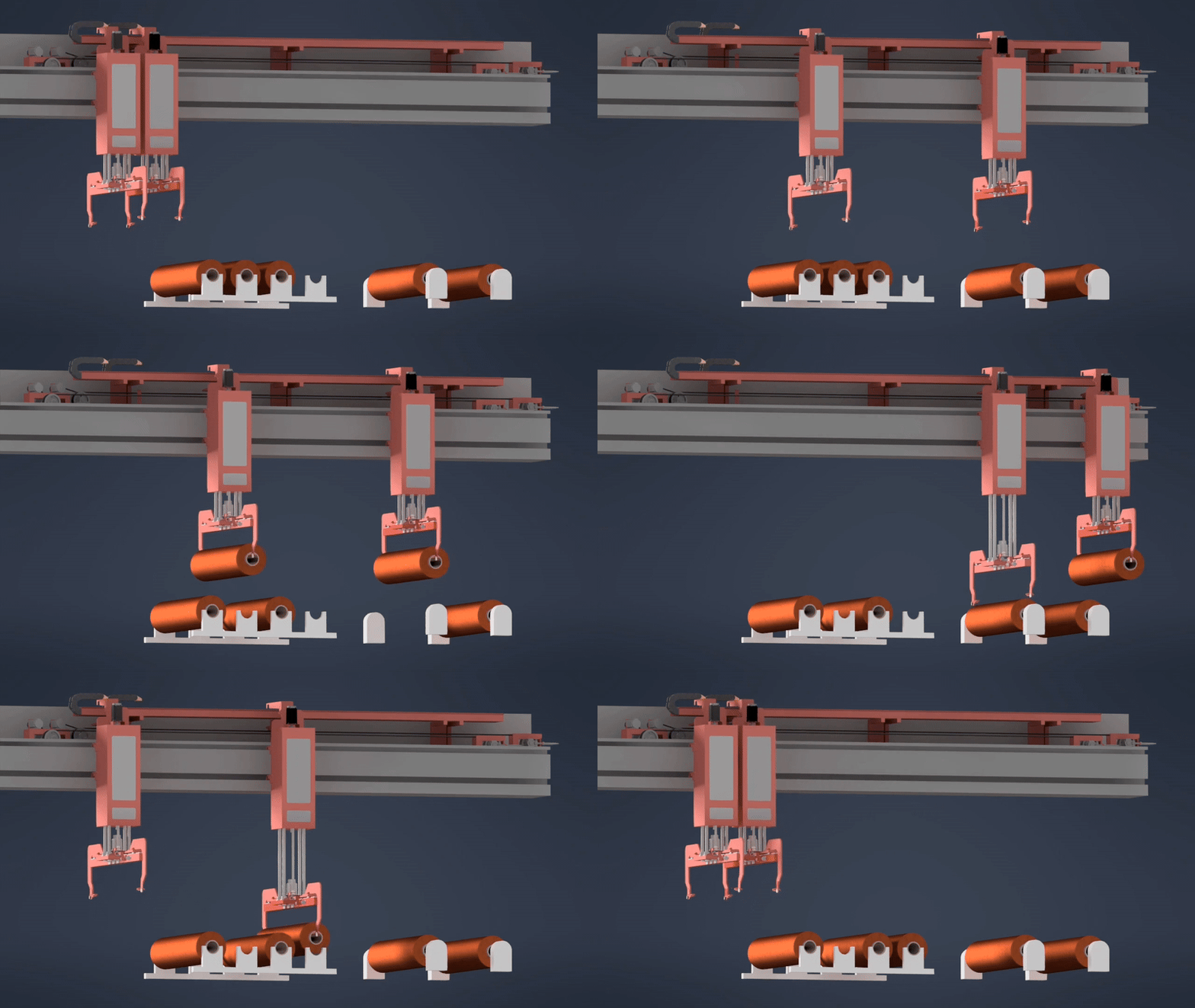
The selected concept places two independently driven hoists on the existing gantry. Each hoist contains:
- an X-axis carriage for horizontal travel;
- a ball-screw Z-axis for lifting;
- a rack-and-pinion Y-axis/end effector for engaging the roll; and
- optical through-beam sensing to verify roll presence.
Using two carriages allows one hoist to handle the outgoing roll while the other prepares the replacement, reducing idle motion and keeping operators at a safer distance.
My Contributions
- Developed the X-axis CAD design, motor mounts, support structure, and packaging allowances.
- Produced electrical schematics and wiring-harness documentation.
- Contributed to subsystem integration, design reviews, the bill of materials, and project scheduling.
- Supported CAD iteration, simulation planning, and communication with the industrial partner.
Results and Validation
The project scope was a detailed, analysis-backed design rather than a fabricated full-scale machine. MATLAB/Simulink models predicted a 36-second worst-case changeover—meeting the 40-second requirement and representing a 70% reduction from the existing two-minute process. SolidWorks FEA verified the design against the 700 lb operating load, and the selected components supported the clean-room requirement.
The final package included mechanical and electrical designs, CAD drawings, a control-flow concept, BOM, cost information, FEA, and dynamic simulations.
Team
Sai Srinivas Tatwik Meesala, Samir Strasser, Reagan Gillespie, and Litzi Matancillas. Developed with Isola for EGR 401/402 at Arizona State University.