<?xml version="1.0" encoding="utf-8"?><feed xmlns="http://www.w3.org/2005/Atom" ><generator uri="https://jekyllrb.com/" version="3.10.0">Jekyll</generator><link href="https://tatwik19.github.io/feed.xml" rel="self" type="application/atom+xml" /><link href="https://tatwik19.github.io/" rel="alternate" type="text/html" /><updated>2025-12-16T13:20:10-07:00</updated><id>https://tatwik19.github.io/feed.xml</id><title type="html">Tatwik Meesala</title><subtitle>Tatwik Meesala&apos;s Personal Website</subtitle><author><name>Sai Srinivas Tatwik Meesala</name><email>tatwik&lt;dot&gt;m&lt;dot&gt;19&lt;at&gt;gmail&lt;dot&gt;com</email></author><entry><title type="html">Featured in The New York Times: Robotics and Advanced Manufacturing at ASU</title><link href="https://tatwik19.github.io/posts/2025/12/nytimes/" rel="alternate" type="text/html" title="Featured in The New York Times: Robotics and Advanced Manufacturing at ASU" /><published>2025-12-06T00:00:00-07:00</published><updated>2025-12-06T00:00:00-07:00</updated><id>https://tatwik19.github.io/posts/2025/12/NY-Times</id><content type="html" xml:base="https://tatwik19.github.io/posts/2025/12/nytimes/"><![CDATA[<h2 id="featured-in-the-new-york-times">Featured in The New York Times</h2>

<p>I am pleased to share that my work in robotics and advanced manufacturing at Arizona State University was recently featured in <em>The New York Times</em> as part of its coverage of ASU’s new Robotics Lab and the rapid growth of the semiconductor ecosystem in the Phoenix area.</p>

<p>The reporting highlights how robotics, automation, and advanced manufacturing are central to the region’s development into a major technology and semiconductor hub, and how institutions such as ASU are building the workforce needed to support these large-scale projects.</p>

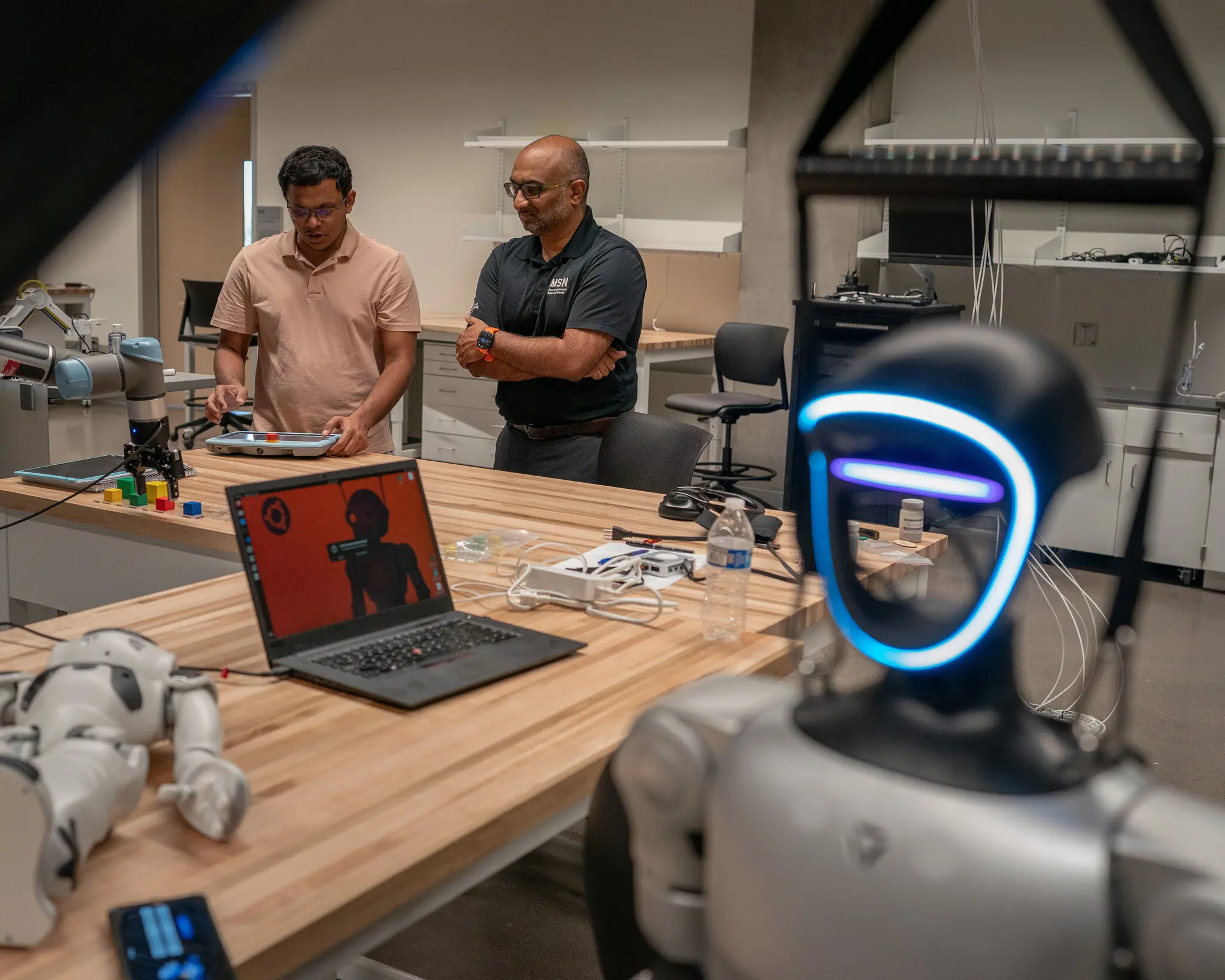
<p><img src="/assets/04_BlogPosts/01_img.png" alt="Robotics lab at Arizona State University featured in The New York Times" /></p>

<h2 id="asu-robotics-and-workforce-development">ASU Robotics and Workforce Development</h2>

<p>ASU’s School of Manufacturing Systems and Networks is presented as an example of how modern manufacturing education is changing: highly automated laboratories, industrial robots, autonomous systems, and realistic production environments that mirror what students will encounter in semiconductor fabs and other advanced manufacturing facilities.</p>

<p>In this context, our Robotics Lab is positioned as a place where students can gain hands-on experience with intelligent robotic systems, experiment with automation strategies, and understand how robotics integrates with larger manufacturing systems, from chip fabrication to packaging and assembly.</p>

<h2 id="my-role-in-the-robotics-lab">My Role in the Robotics Lab</h2>

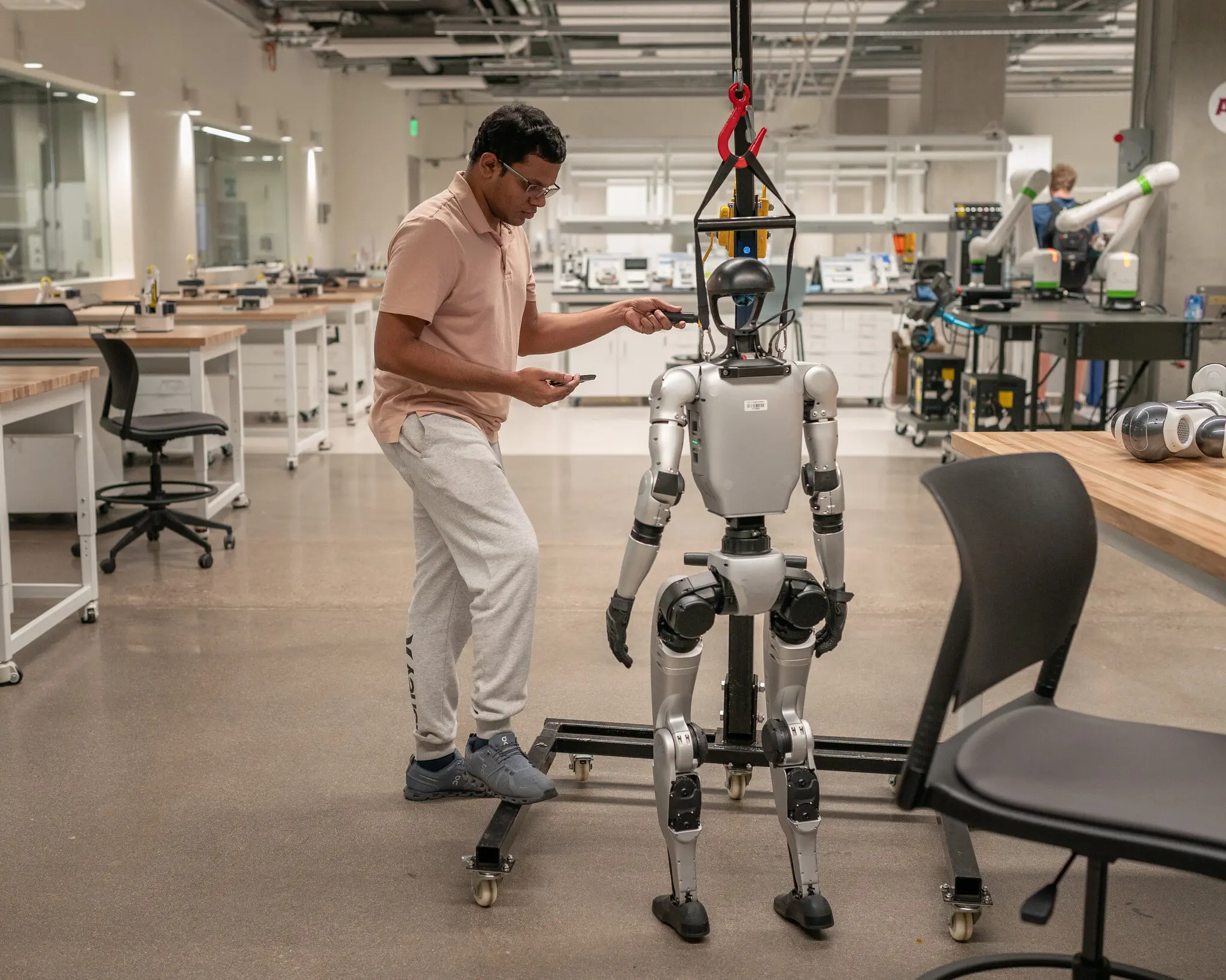
<p>As a doctoral student working in robotics and advanced manufacturing at Arizona State University, I contribute to research and development efforts within the Robotics Lab in the School of Manufacturing Systems and Networks. Being included in this coverage is a reflection of the broader team effort—faculty, students, staff, and industry collaborators—who are collectively working to connect academic research with practical manufacturing applications.</p>

<p><img src="/assets/04_BlogPosts/02_img.png" alt="Working with a robot at ASU’s School of Manufacturing Systems and Networks" /></p>

<h3 id="acknowledgments">Acknowledgments</h3>

<p>I am grateful to <strong>Prof. Binil Starly</strong> for his leadership and for clearly articulating the highly automated and robotics-driven nature of modern manufacturing, and to <strong>Prof. Sangram Redkar</strong> for his continuous guidance and support. Their mentorship has been central to shaping my work and to ASU’s contribution to the semiconductor and advanced manufacturing ecosystem in Arizona.</p>

<h3 id="read-the-articles">Read the Articles</h3>

<ul>
  <li>
    <p><a href="https://www.nytimes.com/2025/12/04/business/tsmc-arizona-workers-training.html">“A Growing U.S. Tech Hub Needs Workers. Colleges Try to Keep Up.”</a></p>
  </li>
  <li>
    <p><a href="https://www.nytimes.com/2025/12/04/business/tsmc-phoenix-fab.html">“18,000 Reasons It’s So Hard to Build a Chip Factory in America”</a></p>
  </li>
</ul>]]></content><author><name>Sai Srinivas Tatwik Meesala</name><email>tatwik&lt;dot&gt;m&lt;dot&gt;19&lt;at&gt;gmail&lt;dot&gt;com</email></author><category term="Robotics" /><category term="Advanced Manufacturing" /><category term="Arizona State University" /><category term="Media" /><summary type="html"><![CDATA[Featured in The New York Times]]></summary></entry><entry><title type="html">Robotics in the Medical Industry and Humanity’s Trust in It</title><link href="https://tatwik19.github.io/posts/2020/06/Robotics-in-the-Medical-Industry-and-Humanity%E2%80%99s-Trust-in-It/" rel="alternate" type="text/html" title="Robotics in the Medical Industry and Humanity’s Trust in It" /><published>2020-06-25T00:00:00-07:00</published><updated>2020-06-25T00:00:00-07:00</updated><id>https://tatwik19.github.io/posts/2020/06/Robotics-in-the-Medical-Industry-and-Humanity%E2%80%99s-Trust-in-It</id><content type="html" xml:base="https://tatwik19.github.io/posts/2020/06/Robotics-in-the-Medical-Industry-and-Humanity%E2%80%99s-Trust-in-It/"><![CDATA[<blockquote>
  <p><em>This Blog post is the AI improved version of the <a href="https://sites.google.com/maricopa.edu/roboticsinthemedicalindustry/home">Original Site</a></em></p>
</blockquote>

<hr />

<h2 id="introduction">Introduction</h2>

<p>Robots are revolutionizing the world, ushering in a new era of technology. Imagine a day in a hospital where a robot delivers a baby, while another performs a complex surgery with precision—just another routine day in healthcare. This future is not far off. Traditionally, engineering and medicine have been seen as separate fields. When people think of robots, they imagine automated butlers, cleaners, or construction bots, rarely considering their potential in medical science. However, trust is a critical factor in the intersection of humanity and technology. Can robots truly be trusted with human lives?</p>

<p>For robots to be accepted in healthcare, they must exhibit— or at least simulate— empathy to gain patient trust. Human doctors possess essential social skills like communication and emotional intelligence, which robots currently lack (Tapus et al.). Yet, with rapid technological advancements, robots are entering the medical field, assisting healthcare professionals in diagnosis, treatment, and even surgery. Although it will take time to build trust in automated procedures, history has shown that integrating engineering with medicine leads to revolutionary inventions. Increasing public confidence in medical robotics could mark the beginning of a new era in healthcare.</p>

<hr />

<h2 id="how-robots-and-humans-treat-each-other">How Robots and Humans Treat Each Other</h2>

<p>Public perception of robots varies. According to a Brookings survey, 61% of U.S. adults are uncomfortable with robots (West). Their mechanical appearance and lack of social skills make some people uneasy (Lin). Others fear them due to misconceptions, influenced by movies and media. However, robots play a crucial role in modern technology, continuously supporting humanity (Davids). As Dialani notes, “There is only a thin line distinction between what people can do and what robots can do.”</p>

<p>A significant concern is that robots will replace human jobs. However, rather than being threats, robots can serve as valuable assistants. In the corporate and healthcare sectors, robots enhance efficiency and safety. For instance, in factories, they improve productivity and assist in handling hazardous machinery, reducing risks for human workers (Davids). Instead of displacing jobs, robots complement human efforts, making workplaces safer and more efficient.</p>

<hr />

<h2 id="the-rise-of-robotic-surgery">The Rise of Robotic Surgery</h2>

<p>Technological advancements have propelled robotic systems as surgical assistants. One notable innovation is the <strong>da Vinci Robotic System</strong>, which combines robotic technology with telemanipulation. This system enables surgeons to perform precise, minimally invasive procedures using a console that provides a 3D view of the patient’s body (S et al.).</p>

<p>The <strong>da Vinci System</strong> comprises three components:</p>
<ul>
  <li><strong>Surgeon Console:</strong> Allows the surgeon to control robotic instruments and view the surgical area in 3D.</li>
  <li><strong>Patient Cart:</strong> Contains cameras and surgical instruments controlled by the surgeon.</li>
  <li><strong>Vision Cart:</strong> Facilitates communication between the console and patient cart while supporting 3D imaging (“About Da Vinci System”).</li>
</ul>

<p>This system is used in various procedures, including cardiac, gynecological, urological, and thoracic surgeries. Robotic surgery offers benefits such as smaller incisions, reduced scarring, less blood loss, and faster recovery (“Benefits of Davinci Robotic Surgery System”).</p>

<p>Another groundbreaking robot, <strong>Versius</strong>, developed by a British company, rivals the da Vinci system with its compact, flexible design. Versius enhances surgical precision while minimizing patient discomfort and recovery time (Walsh). The continuous evolution of robotic surgery is proving its value, improving both patient outcomes and hospital efficiency.</p>

<hr />

<h2 id="other-applications-of-robots-in-the-medical-industry">Other Applications of Robots in the Medical Industry</h2>

<p>Beyond surgery, robots are transforming other areas of healthcare. Thoughtful integration of artificial intelligence (AI) and robotics can enhance hospital operations, streamline patient care, and improve efficiency.</p>

<ul>
  <li><strong>Nursing Assistance:</strong> AI-powered robots, like those developed by <strong>Diligent Robotics</strong>, assist in routine nursing tasks such as fetching supplies (Clipper et al.).</li>
  <li><strong>Medical Transportation:</strong> Robots deliver medical supplies and meals to patients, reducing human workload.</li>
  <li><strong>Sanitation &amp; Disinfection:</strong> During pandemics, robots help disinfect hospital surfaces, preventing the spread of infections like <strong>Ebola and COVID-19</strong> (Crawford).</li>
  <li><strong>Advanced Surgeries:</strong> Robots assist in complex procedures like esophageal, pancreatic, and colorectal surgeries, improving precision and patient safety (Giulianotti et al.).</li>
</ul>

<hr />

<h2 id="improving-humanitys-trust-in-robots">Improving Humanity’s Trust in Robots</h2>

<p>For robotics to thrive in healthcare, trust is essential. Certain criteria must be met for humans to accept robots as reliable partners.</p>

<p>Social phenomenology, as defined by Crossman, studies how human awareness shapes social interactions. Trust in robots should develop naturally, without coercion. Coeckelbergh emphasizes that for trust to exist, delegation must be voluntary, and the relationship should be free from excessive supervision (Coeckelbergh 56). Furthermore, social interactions play a crucial role in fostering confidence in robotics.</p>

<hr />

<h2 id="interaction-between-robots-and-their-environment">Interaction Between Robots and Their Environment</h2>

<p>Understanding robot-environment interaction is vital for their effective implementation in healthcare. A robot’s behavior is shaped by three key factors: <strong>the robot, the task, and the environment</strong> (Nehmzow and Walker). By analyzing human experiences with robots, engineers can program them to adapt to hospital environments, improving their integration into daily medical operations (Lin).</p>

<p>Structural hospital features, such as room layouts and supply arrangements, influence how robots navigate and perform tasks. AI algorithms allow robots to locate and transport supplies efficiently, assisting in hospital logistics (Clipper et al.).</p>

<hr />

<h2 id="conclusion">Conclusion</h2>

<p>Rather than perceiving robots as threats, society should embrace them as allies. Robots can work alongside humans, assist in challenging tasks, and even provide companionship. The real danger is not robotics itself, but humanity’s unfounded fears and reluctance to embrace change.</p>

<p>Robotics is making significant strides in all industries, especially in healthcare. The collaboration between engineers and doctors is leading to groundbreaking innovations. Robots assist in surgeries, nursing, sanitization, and transportation, playing a crucial role in medical advancements. They can also be invaluable during global health crises, such as pandemics.</p>

<p>Ultimately, robots are tools designed to aid humanity. The real question is not whether robots can be trusted—it is whether humans can trust themselves to use robots responsibly. With proper oversight, robotics can lead the medical industry into a safer, more efficient future.</p>

<hr />

<h3 id="thank-you-for-reading"><strong>Thank You for Reading!</strong></h3>
<hr />
<hr />
<h2 id="works-cited">Works Cited</h2>

<ul>
  <li>About Da Vinci System. Intuitive, 2020, www.davincisurgery.com/da-vinci-systems/about-da-vinci-systems.</li>
  <li>Advantages and Disadvantages of Robotic Technology in Urology. Advanced Urology Institute, 26 Mar. 2020, www.advancedurologyinstitute.com/advantagesdisadvantages-robotic-technology-urology/.</li>
  <li>Aggarwal, R., J. Hance, and A. Darzi. “Robotics and Surgery: A Long-term Relationship?” International Journal of Surgery 2.2 (2004): 106-109.</li>
  <li>Benefits of Davinci Robotic Surgery System. Desert West Surgery, www.desertwestsurgery.com/blog/benefits-of-davinci-robotic-surgery-system.</li>
  <li>Clipper, Bonnie, Joyce Batcheller, Andrea Thomaz, and Agata Rozga. “Artificial Intelligence and Robotics: A Nurse Leader’s Primer.” Nurse Leader, vol. 16, no. 6, 2018, pp. 379–384., doi:10.1016/j.mnl.2018.07.015.</li>
  <li>Coeckelbergh, Mark. “Can We Trust Robots?” Ethics and Information Technology, vol. 14, no. 1, 2011, pp. 53–60., doi:10.1007/s10676-011-9279-1.</li>
  <li>Crawford, Mark. Top 6 Robotic Applications in Medicine. 10 Apr. 2017, aabme.asme.org/posts/top-6-robotic-applications-in-medicine.</li>
  <li>Crawford, Ross, Jonathan Roberts, and Anjali Jaiprakash. Surgeons Have Admitted That Robots Would Prevent Mistakes in Surgery. 28 June 2017, www.weforum.org/agenda/2017/06/surgeons-have-admitted-that-robots-would-prevent-mistakes-in-surgery.</li>
  <li>Crossman, Ashley. What Is Social Phenomenology? 12 Jan. 2018, www.thoughtco.com/phenomenology-sociology-3026630.</li>
  <li>Davids, Mariane. 3 Reasons Why People Are Afraid of Robots (And Why They Shouldn’t Be). 24 July 2017, blog.robotiq.com/3-reasons-people-are-afraid-of-robots-and-why-they-shouldnt-be.</li>
  <li>Dialani, Priya. “Top 7 Benefits of Robots in the Workplace.” Analytics Insight, 4 Jan. 2019, www.analyticsinsight.net/top-7-benefits-of-robots-in-the-workplace/.</li>
  <li>Giulianotti, Pier Cristoforo, Andrea Coratti, and Martin Angelini. “Robotics in General Surgery.” Robotics in General Surgery: Personal Experience in a Large Community Hospital, vol. 138, July 2003, pp. 777–784., doi:10.1001/archsurg.138.7.777.</li>
  <li>K, Iykya. “How Successful and Effective Are Robotic Surgeries?” Medlife Blog Health and Wellness Tips, 29 Feb. 2020, www.medlife.com/blog/how-successful-and-effective-are-robotic-surgeries/.</li>
  <li>Lin, Patrick. Relationships with Robots: Good or Bad for Humans? 1 Feb. 2016, www.forbes.com/sites/patricklin/2016/02/01/relationships-with-robots-good-or-bad-for-humans/.</li>
  <li>Nehmzow, Ulrich, and Keith Walker. “Quantitative Description of Robot–Environment Interaction Using Chaos Theory.” Robotics and Autonomous Systems, vol. 53, no. 3-4, 2005, pp. 177–193., doi:10.1016/j.robot.2005.09.009.</li>
  <li>S, Jeelani, Dany. A, Anand. B, Vandana. S, Maheswaran. T, and Rajkumar. E. “Robotics and Medicine: A Scientific Rainbow in Hospital.” Journal of Pharmacy and Bioallied Sciences, vol. 7, no. 6, 7 Aug. 2015, pp. 381–383., doi:10.4103/0975-7406.163460.</li>
  <li>Schwaibold, Hartwig, et al. “The Age of Robotic Surgery – Is Laparoscopy Dead?” Arab Journal of Urology, vol. 16, no. 3, 2018, pp. 262–269., doi:10.1016/j.aju.2018.07.003.</li>
  <li>Sheetz, Kyle H., Jake Claflin, and Justin B. Dimick. “Trends in the Adoption of Robotic Surgery for Common Surgical Procedures.” JAMA Network Open, vol. 3, no. 1, 2020, doi:10.1001/jamanetworkopen.2019.18911.</li>
  <li>Tapus, Adriana, Mataric Maja, and Brian Scassellati. The Grand Challenges in Socially Assistive Robotics. 23 July 2013, hal.archives-ouvertes.fr/hal-00770113.</li>
  <li>Walsh, Fergus. New Versius Robotic Surgery System Coming to NHS. 3 Sept. 2018, www.bbc.com/news/health-45370642.</li>
  <li>West, Darrell M. “Brookings Survey Finds 52 Percent Believe Robots Will Perform Most Human Activities in 30 Years.” Brookings, 21 June 2018, www.brookings.edu/blog/techtank/2018/06/21/brookings-survey-finds-52-percent-believe-robots-will-perform-most-human-activities-in-30-years/.</li>
</ul>]]></content><author><name>Sai Srinivas Tatwik Meesala</name><email>tatwik&lt;dot&gt;m&lt;dot&gt;19&lt;at&gt;gmail&lt;dot&gt;com</email></author><category term="Robbotics" /><category term="Trust" /><category term="Ethics" /><summary type="html"><![CDATA[This Blog post is the AI improved version of the Original Site]]></summary></entry><entry><title type="html">BADASS WOMEN: Angela Merkel</title><link href="https://tatwik19.github.io/posts/2012/04/BADASS-WOMEN/" rel="alternate" type="text/html" title="BADASS WOMEN: Angela Merkel" /><published>2020-04-22T00:00:00-07:00</published><updated>2020-04-22T00:00:00-07:00</updated><id>https://tatwik19.github.io/posts/2012/04/BADASS-WOMEN</id><content type="html" xml:base="https://tatwik19.github.io/posts/2012/04/BADASS-WOMEN/"><![CDATA[<blockquote>
  <p><em>This Blog post is the AI improved version of the <a href="https://sites.google.com/asu.edu/badasswomenangelamerkel/home">Original Site</a></em></p>
</blockquote>

<h1 id="modern-day-powerful-woman">Modern Day Powerful Woman</h1>
<p><strong>Powerful Women Come with Powerful Hearts</strong></p>

<hr />

<h2 id="family-roots-and-early-life">Family, Roots And Early Life</h2>

<h3 id="-parents">🏡 Parents</h3>
<p>Angela Dorothea Kasner was born on <strong>July 17, 1954</strong>, in Hamburg to her parents <strong>Horst Kasner</strong>, a Lutheran pastor, and <strong>Herlind Kasner</strong>, a teacher.</p>

<h3 id="-siblings">👨‍👧‍👦 Siblings</h3>
<p>Merkel was the oldest of three children. She has <strong>Marcus Kasner</strong>, her brother, a theoretical physicist, and <strong>Irene Kasner</strong>, her sister, an occupational therapist.</p>

<h3 id="-spouserelationships">💍 Spouse/Relationships</h3>
<p>Angela Merkel was married twice. She got her last name from her first husband, <strong>Ulrich Merkel</strong>, a German physicist. After their separation, she married <strong>Joachim Sauer</strong> in 1998.</p>

<h3 id="-life-as-a-child">🏡 Life as a Child</h3>
<p>Merkel’s early years in Germany influenced her life decisions. At three months old, her family moved to East Germany due to her father’s vocation in the Lutheran Church. She excelled academically and was <strong>fluent in Russian</strong>.</p>

<hr />

<h2 id="personality">Personality</h2>

<p>Angela Merkel has a <strong>stunning personality</strong> with an extraordinary ability to influence others. Her science background gives her a strategic mindset, making her a <strong>master networker</strong> and decision-maker.</p>

<blockquote>
  <p><em>“I am, I think, courageous at the decisive moment, but I need a good deal of start-up time, and I try to take as much as possible into consideration beforehand.”</em></p>
</blockquote>

<p>She has a <strong>strict upbringing</strong> due to her theologian father, enjoys <strong>football</strong>, and prefers a <strong>simple lifestyle</strong>, living in her private residence instead of the official one. Merkel also uses <strong>humor</strong> as a tool to navigate challenges.</p>

<hr />

<h2 id="career">Career</h2>

<p>Merkel studied a degree in physics and finished her doctorate in quantum chemistry at the University of Leipzig and she earned her doctorate in Physical Chemistry and began to work at the Central Institute for Physical Chemistry of the Academy of Sciences as a chemist. What’s more, she anticipated turning into a teacher.</p>

<p>She was elected as the chancellor of Germany by both leading parties in 2005 and then she was re-elected as chancellor 2009. For her service towards European unity, she was awarded the Charlemagne Prize in 2009.
As a chancellor, Merkel holds a solid position and capacity to choose the creation of the Federal Cabinet (The Federal Chancellor) and play a game of seat juggling with the pioneers of Germany. Merkel has contributed a great deal to her International issues during her chancellorship and built up Germany’s relationship with other nations. She has worked alone during Europe’s perilous circumstances and enormous displacement in 2015.</p>

<p>She was elected as the chancellor of Germany by both leading parties in 2005 and then she was re-elected as chancellor 2009. For her service towards European unity, she was awarded the Charlemagne Prize in 2009.
As a chancellor, Merkel holds a solid position and capacity to choose the creation of the Federal Cabinet (The Federal Chancellor) and play a game of seat juggling with the pioneers of Germany. Merkel has contributed a great deal to her International issues during her chancellorship and built up Germany’s relationship with other nations. She has worked alone during Europe’s perilous circumstances and enormous displacement in 2015.</p>

<p>Merkel has offered safety zones and vowed to secure a large number of civilians in Syria and caught up with international gatherings with Turkish, French and Russian President to smother disturbing the pressures.</p>

<p>Merkel declared that Germany will change from atomic capacity to environmentally friendly power vitality by 2022 in light of the Fukushima atomic fiasco occurrence that evaluated 7 on the International Nuclear and Radiological Event Scale.</p>

<hr />

<h2 id="milestones">Milestones</h2>

<p><strong>1990</strong> - Press Officer for Democratic Awakening.<br />
<strong>1990</strong> - Elected to the German Bundestag.<br />
<strong>1994</strong> - Minister of the Environment, Nature Conservation, and Nuclear Safety.<br />
<strong>2000</strong> - First female chairperson of the CDU.<br />
<strong>2005</strong> - First female Chancellor of Germany.<br />
<strong>2009</strong> - Re-elected Chancellor &amp; awarded Charlemagne Prize.<br />
<strong>2011</strong> - Received the <strong>Presidential Medal of Freedom</strong> from Barack Obama.<br />
<strong>2015</strong> - Named <strong>Time’s Person of the Year</strong>.<br />
<strong>2017</strong> - Won her <strong>fourth term</strong> as Chancellor.</p>

<hr />

<h2 id="my-playlist-about-her">My Playlist About Her</h2>

<p><strong>God is a Woman</strong> - Celebrates feminine energy.<br />
<strong>Unstoppable (The Score)</strong> - Resilience and perseverance.<br />
<strong>Natural (Imagine Dragons)</strong> - Strength in adversity.<br />
<strong>Woman (Kesha)</strong> - Women’s empowerment.<br />
<strong>Quiet (MILCK)</strong> - Women’s rights and self-expression.<br />
<strong>Just a Girl (No Doubt)</strong> - Breaking gender stereotypes.<br />
<strong>Just Fine (Mary J. Blige)</strong> - Women’s bravery and creativity.<br />
<strong>Juice (Lizzo)</strong> - Confidence and self-love.<br />
<strong>Waka Waka (Shakira)</strong> - A football fan’s anthem.<br />
<strong>Who Let the Dogs Out (Baha Men)</strong> - A humorous nod to Merkel’s fear of dogs.<br />
<strong>Bonus: Ruf mich Angela (Klemen Slakonja)</strong> - A satirical song about her legacy.</p>

<hr />
<h2 id="why-is-she-seen-an-inspiration">Why is she seen an Inspiration?</h2>

<blockquote>
  <p><strong>“Always be more than you appear and never appear to be more than you are.”</strong></p>
</blockquote>

<p>Angela Merkel is <strong>one of the most powerful women in the world</strong> and a role model for many. She has proven that women can lead nations, break barriers, and redefine leadership. Her legacy will inspire future generations of female politicians and leaders. Women belong <strong>not just beside men, but ahead</strong>.</p>

<hr />
<hr />
<h2 id="references">References</h2>

<p>Bailey, R. (2014, May 12). 20 High-Profile Politicians and Their Football Teams. Retrieved April 21, 2020, from https://bleacherreport.com/articles/1987654-20-high-profile-politicians-and-their-football-teams
Business Insider. (2017, August 24). Five defining moments in Merkel’s career. Retrieved from https://www.businessinsider.com/afp-five-defining-moments-in-merkels-career-2017-8 
CNN Library. (2019, July 12). Angela Merkel Fast Facts. Retrieved March 14, 2020, from https://www.cnn.com/2012/12/30/world/europe/angela-merkel—fast-facts/index.html 
Dieter, H. (2019, January 23). After Merkel: Germany’s Role in International Affairs - AIIA. Retrieved April 1, 2020, from http://www.internationalaffairs.org.au/australianoutlook/after-merkel-germanys-role-international-affairs/ 
Henrico, V. (2019, April 13). Angela Merkel Childhood Story Plus Untold Biography Facts. Retrieved April 21, 2020, from https://childhoodbiography.com/angela-merkel-childhood-story-plus-untold-biography-facts/ 
Hurriyet Daily News. (2020, March 3). Merkel calls for ‘protected zone’ in northwest Syria - World News. Retrieved April 1, 2020, from https://www.hurriyetdailynews.com/merkel-calls-for-protected-zone-in-northwest-syria-152637 
Kasner, D. A.,(n.d.). Quotefancy. Retrieved April 22, 2020, from https://quotefancy.com/quote/1324014/Angela-Merkel-Always-be-more-than-you-appear-and-never-appear-to-be-more-than-you-are 
The Federal Chancellor. (n.d.). Tasks of the Chancellor. Retrieved April 1, 2020, from https://www.bundeskanzlerin.de/bkin-en/chancellery/tasks-of-the-chancellor 
Meesala , S. S. T., &amp; Strait, E. (2019). Badass Women: Angela Merkel Modern Day Powerful Woman. 
Noack, R. (2017, June 30). Why Angela Merkel, known for embracing liberal values, voted against same-sex marriage. Retrieved March 16, 2020, from https://www.washingtonpost.com/news/worldviews/wp/2017/06/30/why-angela-merkel-known-for-embracing-liberal-values-voted-against-same-sex-marriage/. 
Qvortrup, M. (2017, September 23). Meet Merkel’s ‘girl camp’: The secretive group of women keeping the German Chancellor in power. Retrieved April 1, 2020, from https://www.telegraph.co.uk/women/politics/meet-merkels-girl-camp-secretive-group-women-keeping-german/ 
Vick, K., &amp; Shuster, S. (2015). TIME Person of the Year 2015: Angela Merkel. Retrieved March 16, 2020, from https://time.com/time-person-of-the-year-2015-angela-merkel/</p>]]></content><author><name>Sai Srinivas Tatwik Meesala</name><email>tatwik&lt;dot&gt;m&lt;dot&gt;19&lt;at&gt;gmail&lt;dot&gt;com</email></author><category term="Powerful Women" /><category term="Germay" /><category term="Chancellor" /><summary type="html"><![CDATA[This Blog post is the AI improved version of the Original Site]]></summary></entry><entry><title type="html">The Golden Age of Barbarians</title><link href="https://tatwik19.github.io/posts/2020/04/The-Golden-Age-of-Barbarians/" rel="alternate" type="text/html" title="The Golden Age of Barbarians" /><published>2020-04-14T00:00:00-07:00</published><updated>2020-04-14T00:00:00-07:00</updated><id>https://tatwik19.github.io/posts/2020/04/The-Golden-Age-of-Barbarians</id><content type="html" xml:base="https://tatwik19.github.io/posts/2020/04/The-Golden-Age-of-Barbarians/"><![CDATA[<h3 id="authors">Authors:</h3>
<ul>
  <li><strong>Sai Srinivas Tatwik Meesala</strong></li>
  <li><strong>Ethan Strait</strong></li>
  <li><strong>Dylan McMillian</strong></li>
  <li><strong>Nolan Featherstun</strong></li>
  <li><strong>Benjamin Swartz</strong></li>
</ul>

<blockquote>
  <p><em>This Blog post is the AI improved version of the <a href="https://sites.google.com/asu.edu/the-golden-age-of-barbarians/home">Original Site</a></em></p>
</blockquote>

<hr />

<p><em>“When the word ‘Barbarian’ rings a bell, we tend to think of brutal behavior and uncivilized actions. But were they truly like that, or was it simply the perspective of the societies around them?”</em></p>

<hr />

<h2 id="who-were-barbarians">Who Were Barbarians?</h2>

<h3 id="civilizations-and-their-barbarian-penumbra">Civilizations and Their Barbarian Penumbra</h3>
<h4 id="by-benjamin-swartz"><em>By Benjamin Swartz</em></h4>

<p>The word <strong>Barbarian</strong> refers to an <em>uncivilized person</em> or <em>malicious people</em>, or in the Greek sense, <strong>one who does not speak Greek</strong>. The Greeks viewed all non-Greek speakers as barbarians because all they heard was <em>“bar, bar, bar.”</em></p>

<p><strong>Commonly labeled Barbarians:</strong><br />
🛡️ <em>Mongols</em><br />
🛡️ <em>Amorites</em><br />
🛡️ <em>Xiongnu</em><br />
🛡️ <em>Huns</em><br />
🛡️ <em>Goths</em><br />
🛡️ <em>Scythians</em></p>

<p>Barbarian warfare was <strong>brutal and relentless</strong>, often destroying entire villages and civilizations. They lacked the <strong>structured armies</strong> of Rome and Greece but compensated with <strong>ferocity, speed, and overwhelming attacks</strong>.</p>

<blockquote>
  <p><em>“The beast-like nature of the barbarians plagued and devastated the entire world.”</em></p>
</blockquote>

<hr />

<h2 id="barbarian-geography-barbarian-ecology">Barbarian Geography, Barbarian Ecology</h2>

<h3 id="barbarian-ecology">Barbarian Ecology</h3>
<h4 id="by-nolan-featherstun"><em>By Nolan Featherstun</em></h4>

<p>Barbarians such as the <strong>Xiongnu</strong> and <strong>Germanic tribes</strong> were <strong>pastoral nomads</strong>, living off:</p>
<ul>
  <li><strong>Grazing livestock</strong> 🐑🐎</li>
  <li><strong>Producing wool, milk, and cheese</strong> 🧀</li>
  <li><strong>Residing in portable huts and encampments</strong> ⛺</li>
</ul>

<p>Their homelands were <strong>harsh and unfit for urbanization</strong>, often <strong>mountainous and forested</strong>, pushing them toward a <strong>nomadic lifestyle</strong>.</p>

<hr />

<h2 id="trade-routes-and-taxable-grain-cores">Trade Routes and Taxable Grain Cores</h2>

<h4 id="by-sai-srinivas-tatwik-meesala"><em>By Sai Srinivas Tatwik Meesala</em></h4>

<h3 id="the-barbarian-way-of-trade">The Barbarian Way of Trade</h3>

<blockquote>
  <p><em>“Barbarians were more than just raiders—they were also traders.”</em></p>
</blockquote>

<ul>
  <li>They <strong>raided and traded</strong> with neighboring empires.</li>
  <li>The <strong>Romans</strong> paid <strong>Celts</strong> to avoid raids while engaging in trade.</li>
  <li><strong>Xiongnu’s dominance</strong> allowed them to control <strong>Central Asian trade routes</strong>.</li>
  <li><strong>Mongols expanded global trade</strong>, protecting merchants and offering <strong>tax exemptions</strong>.</li>
</ul>

<p>🛤️ The <strong>Silk Road</strong> facilitated <strong>exchanges of spices, textiles, and iron</strong> between East and West.</p>

<hr />

<h2 id="barbarian-raiding">Barbarian Raiding</h2>

<h4 id="by-dylan-mcmillian"><em>By Dylan McMillian</em></h4>

<blockquote>
  <p><em>“Barbarians were not just conquerors; their raids were often driven by survival.”</em></p>
</blockquote>

<ul>
  <li>Many <strong>Germanic raids</strong> were due to <strong>Hun aggression</strong>.</li>
  <li>They forced <strong>Romans to fight in dense forests</strong>, where <strong>Roman tactics failed</strong>.</li>
  <li>Their success came from <strong>guerilla tactics and unpredictability</strong>.</li>
</ul>

<hr />

<h2 id="references">References</h2>
<ul>
  <li>Burns, T. S. (2003). Rome and the Barbarians 100 BC – AD 400. Retrieved from http://www.fsmitha.com/review/r-burns.htm</li>
  <li>Giotto, J. Barbarian Invasion of the Roman Empire. Retrieved April 4, 2020 from  https://www.penfield.edu/webpages/jgiotto/onlinetextbook.cfm?subpage=1492781</li>
  <li>ongol Trade: Linking East to West. (2018, March 23). Retrieved April 3, 2020, from https://www.historyonthenet.com/mongol-trade-linking-east-to-west</li>
  <li>Scott, J. C. (2018). Against the grain: a deep history of the earliest states. Place of publication not identified: Yale University Press.</li>
  <li>Shepherd, W. (1911). Map of Gaul in the Time of Caesar. Retrieved April 3, 2020, from http://www.emersonkent.com/map_archive/gaul_1st_cent_bc.htm</li>
  <li>Szostak, J., Waugh, D., Thomas, C. G., Neelis, J., &amp; Jenott, L. (n.d.). The Xiongnu. Retrieved April 4, 2020, from https://depts.washington.edu/silkroad/exhibit/xiongnu/essay.html#notes</li>
  <li>Tucker, D. (1998). Fighting Barbarians. Retrieved April 5, 2020, 	from 	https://web.nps.edu/Academics/Centers/CTIW/files/Fighting%20Barbarians.pdf</li>
  <li>Waugh, D. C. (n.d.). The Xiongnu. Retrieved April 4, 2020, from 	https://depts.washington.edu/silkroad/exhibit/xiongnu/essay.html</li>
</ul>]]></content><author><name>Sai Srinivas Tatwik Meesala</name><email>tatwik&lt;dot&gt;m&lt;dot&gt;19&lt;at&gt;gmail&lt;dot&gt;com</email></author><category term="History" /><category term="Barbarians" /><summary type="html"><![CDATA[Authors: Sai Srinivas Tatwik Meesala Ethan Strait Dylan McMillian Nolan Featherstun Benjamin Swartz]]></summary></entry></feed>